Why Construction Teams Need to Know the Story Behind Every Decision Made
Every construction project is shaped by thousands of decisions. Knowing what was decided is important, but understanding why a decision was made, what informed it and what followed can be just as valuable.
A construction project is built through decisions.
Some are large.
Others may seem insignificant at the time.
A design is changed.
A material is approved.
A site issue is resolved.
A variation is accepted.
A contractor raises a concern.
A consultant provides clarification.
A stakeholder makes a request.
Someone reviews the information available and decides what should happen next.
Months later, someone may need to ask a simple question:
Why was that decision made?
And that is when the real challenge can begin.
A Decision Is More Than Its Final Outcome
Project records can tell you what was decided.
But the final decision is only one part of the story.
There was information behind it.
There were people involved.
There may have been alternatives.
There may have been concerns.
There may have been approvals.
There may have been conversations that influenced the final outcome.
Understanding that history can matter just as much as knowing the final answer.
Without the reasoning and context behind a decision, a project team may know what happened without knowing why it happened.
Construction Projects Create Decision Histories
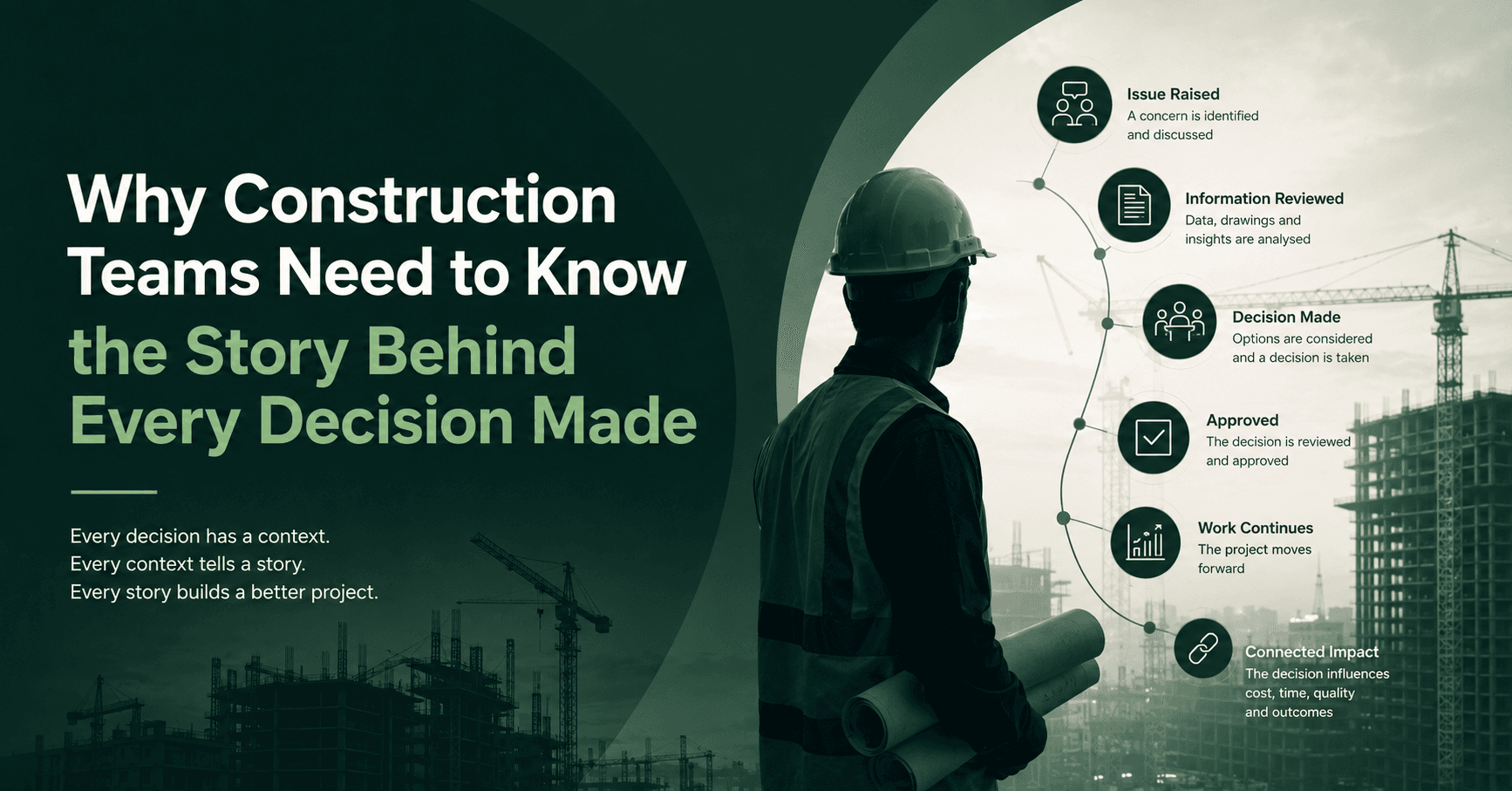
Every project develops a history as work progresses.
A drawing is revised.
A problem appears on site.
A question is raised.
A meeting takes place.
A solution is proposed.
An approval is given.
The work continues. Then another change occurs.
These events are connected.
One decision can influence another.
A change to a design can affect procurement.
A procurement decision can affect scheduling.
A site decision can affect cost.
An approval can determine what work can proceed.
The project is therefore not simply a collection of individual events.
It is a chain of connected decisions and consequences.
What Happens When That Story Gets Lost?
Imagine a team discovers an issue several months after a decision was made.
They need to understand what happened.
So they start searching through project records.
They find the relevant document.
Then they look for an email.
Then a meeting note.
Then an approval.
Then another document that references the original decision.
Someone remembers part of the conversation.
Another person remembers something different.
The team eventually begins reconstructing the history.
That takes time.
And depending on how well the information was preserved, the full story may never be completely clear.
Context Can Be More Valuable Than the Record
A project document can tell you what was approved.
A meeting record can tell you what was discussed.
An email can tell you what someone communicated.
But the real project story often exists across all of them.
The value comes from understanding how those pieces connect.
Who raised the issue?
What information was available?
What options were considered?
Who made the decision?
Who approved it?
What changed afterwards?
What did the decision affect?
These questions provide context.
And context can change how a team understands a decision.
Why This Matters When Projects Change Hands
Construction projects involve many people over long periods.
Teams change.
Contractors change.
Consultants come and go.
New project managers take over.
People who were involved in an earlier decision may no longer be available when questions arise.
The project, however, continues.
Its knowledge should continue with it.
A new team member should not have to depend entirely on someone’s memory to understand why an important decision was made months earlier.
The project should retain its history.
Better Project Intelligence Connects the Story
This is where construction intelligence becomes more than simply collecting project information.
The goal is not to create another storage system filled with documents.
The goal is to make project knowledge more connected and useful.
When decisions, approvals, changes and project information can be understood in relation to one another, teams gain a clearer picture of the project.
They can see not only what happened, but the circumstances surrounding it.
That can help teams respond more intelligently when new issues arise.
Decisions Have Consequences
A decision made on one part of a project can have consequences somewhere else.
That is why understanding the story behind a decision matters.
A decision may influence a schedule.
It may affect a cost.
It may change a design.
It may create a new approval requirement.
It may introduce a new risk.
The further a project progresses, the more difficult it can become to understand these relationships if the knowledge behind them is not connected.
The Future of Construction Intelligence
Construction intelligence should help teams move beyond simply finding information.
It should help them understand it.
When a team asks:
What happened?
They should be able to find the answer.
When they ask:
Why did it happen?
They should be able to understand the context.
And when they ask:
What does this decision affect?
They should have the intelligence needed to investigate the wider project impact.
That is a much more useful way to think about project knowledge.
Where ZiriEzi Fits
ZiriEzi is a Construction Intelligence solution designed to help teams connect project knowledge, decisions, approvals and context throughout the project lifecycle.
Its Decision Twin intelligence helps teams understand the relationships surrounding project decisions rather than treating each piece of information as an isolated record.
Because a construction project should not only remember what was decided.
It should preserve the story behind those decisions.
Ready to Build Smarter From Day One?
See how ZiriEzi helps construction teams connect project knowledge, approvals and Decision Twin intelligence before delays become expensive.
Learn more at www.ziriezi.com or contact hello@ziriezi.com
Tags
See ZiriEzi in action
One login, one bill, one platform for everything your site runs.
Observations, permits, inspections, attendance, document control, reporting — all in one place. Book a 30-minute demo to see how it works on your sites.
Book a demo →